Luxury Vinyl Tile (LVT) Flooring
The look of stone and ceramic, without the cold, the cracks, or the grout.
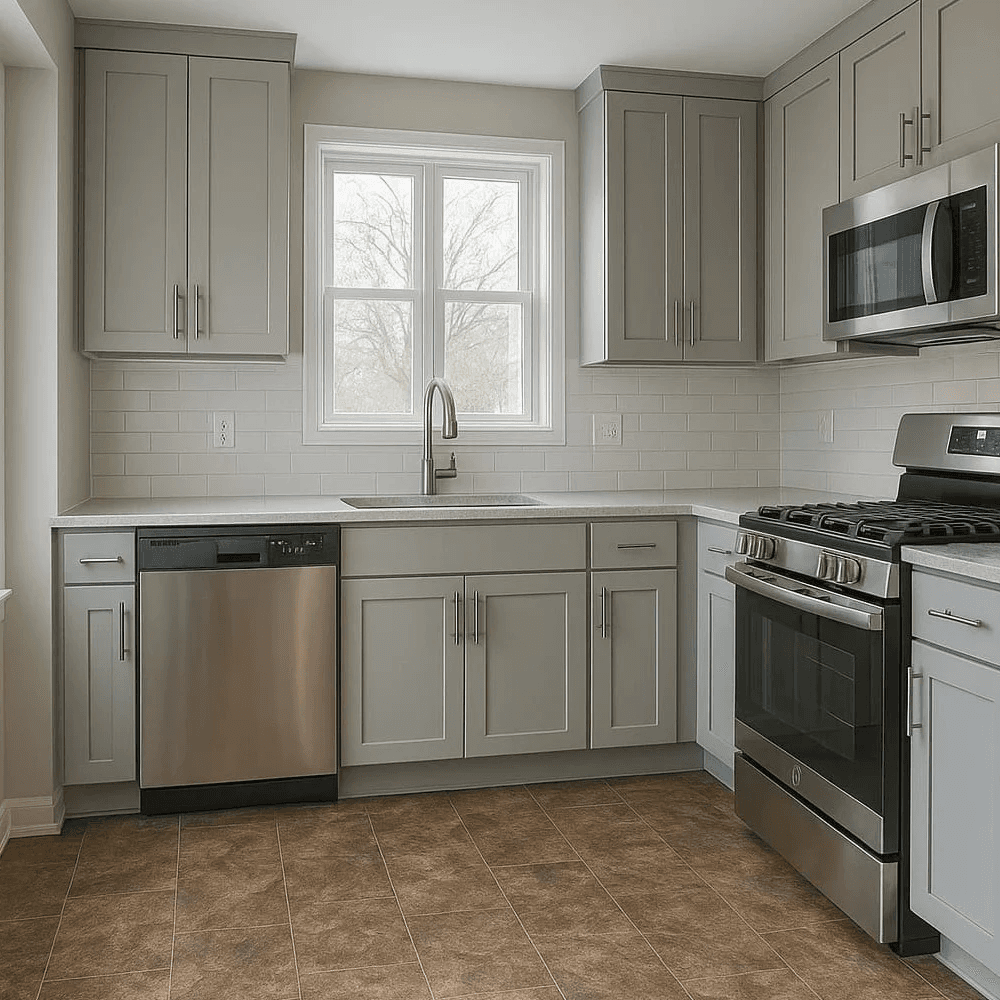
Luxury vinyl tile gives you travertine, slate, or marble visuals in a material that is warmer underfoot, more forgiving on a dropped glass, and far less brittle than the real thing. It is our default recommendation for bathrooms, laundry rooms, and mudrooms across Brunswick and Cleveland.
At a glance
- Water resistance
- Fully waterproof core
- Typical lifespan
- 15–25 years residential
- Relative cost
- $$ — mid-range
- Below-grade use
- Yes — basements included
- Refinishable
- No — replace tiles instead
- Install method
- Glue-down or click-lock, groutable options
✓Where it works best
- —Full bathrooms and powder rooms
- —Laundry rooms and mudrooms
- —Kitchens where a stone look is wanted
- —Basements with a stone or tile aesthetic
- —Anyone who wants tile visuals with underfoot warmth
!Where we’d steer you elsewhere
- —Clients who want the exact acoustic ring and heft of real porcelain
- —Spaces where a heated floor system is already installed under existing tile
- —Wood-look layouts — luxury vinyl plank is the better format there
LVT and LVP are the same material in a different shape
Luxury vinyl tile and luxury vinyl plank are built identically — waterproof core, printed design layer, clear wear layer. The difference is format and imagery. LVP comes in long, narrow boards printed with wood grain. LVT comes in squares or large-format rectangles printed with stone, slate, travertine, marble, or concrete. Everything true about LVP's durability and water resistance is equally true here.
That means the choice between them is mostly aesthetic and room-driven. Where you would have considered ceramic or porcelain tile, look at LVT. Where you would have considered hardwood, look at LVP. We regularly run LVP through the main living areas of a house and switch to LVT in the bathrooms, using a threshold at the doorway to make the transition deliberate.
Why it beats ceramic in most Ohio bathrooms
Ceramic and porcelain are excellent materials with three real drawbacks in a residential bathroom: they are cold, they are hard, and they crack. LVT is meaningfully warmer to bare feet in February, which matters more than people expect in a Northeast Ohio winter. It has enough give that a dropped bottle bounces instead of chipping the floor. And it flexes slightly with the structure rather than cracking along a grout line when a joist moves.
It is also faster and less invasive to install. There is no mortar bed, no multi-day cure, and no wet saw filling the house with slurry dust. For a bathroom refresh where the client wants to be back in the room quickly, that difference is significant.
Grout, or no grout
Some LVT lines are groutable: the tiles install with a small deliberate gap that gets filled with a flexible acrylic grout. This is what makes an LVT floor genuinely difficult to distinguish from ceramic at a glance, because the grout line reads as the real thing. It also adds a maintenance surface that can stain over time, the same as any grout.
Groutless installs butt the tiles tightly together for a continuous, seamless surface. It is faster, easier to clean, and reads as a modern large-format look. Neither approach affects waterproofing — the core does that work regardless. We walk through both options with the actual product in hand before ordering, because the two look quite different in a finished room.
Substrate matters more with large-format tile
Large-format LVT is less forgiving than plank about subfloor flatness, and for a simple geometric reason: a wide, rigid square spans a dip that a narrow plank would follow. A low spot the eye cannot see becomes a tile that rocks slightly underfoot, and in a glue-down install it becomes a hollow spot where the adhesive never made full contact.
So the assessment before a bathroom or laundry install is not a formality. We check flatness, we check moisture — especially on a slab or over a crawlspace — and any leveling or subfloor repair required is assessed and priced separately from the installation itself, with your approval before any of it starts.
Where LVT earns its keep beyond the bathroom
Mudrooms and laundry rooms are the strongest case in an Ohio home. Both see standing water as a normal condition rather than an accident — snowmelt off boots, a washer hose that weeps. A stone-look LVT with a decent wear layer handles that indefinitely, and the pattern hides road salt residue between cleanings far better than a wood-look plank does.
It also works well in a basement where the client wants something that does not read as a wood floor pretending to be upstairs. A slate or concrete-look LVT accepts the fact that it is a lower level and turns it into a design decision rather than a compromise.
Common questions about luxury vinyl tile
Can LVT be installed over existing ceramic tile?
Often yes, if the existing tile is well bonded, structurally sound, and the grout lines are filled and skim-coated flat first. Telegraphing grout lines through the new floor is the risk, so that flattening step is not optional. We assess this on-site and quote the prep separately.
Does luxury vinyl tile need to be sealed?
No. The wear layer is the seal. If you choose a groutable line, the grout itself may benefit from a sealer depending on the product — we'll tell you which one you have.
Is LVT slippery when wet?
Less than polished porcelain, which is a real advantage in a bathroom. Textured and embossed finishes give more grip than high-gloss ones, and that's worth weighing if the floor is going in a bathroom used by kids or anyone with mobility concerns.
Can it go over a heated floor?
Most LVT is compatible with in-floor radiant heat, but there is a maximum surface temperature — typically around 85°F — that must be respected or the tile can distort. Always confirm against the specific product's spec sheet before committing.
See luxury vinyl tile in your own room.
Upload a photo of your space and preview this flooring type with our free AI visualizer — then request an itemized estimate with no obligation.
Every quote is itemized. Floor preparation — leveling, subfloor repairs, moisture barriers — is assessed on-site and priced separately, with your approval before any work begins.